
IJAS Special Issue: New work in 19th-Century Historical and Literary studies
Standard histories of the abolitionist movement make few references to the activities of black Americans in Britain. The history of the movement has traditionally been viewed as almost synonymous with the history of organized abolitionist societies, and analyses have been almost entirely limited to accounts of contacts between the activities of such societies. These studies have understandably placed great emphasis on the personal correspondence, minutes, reports, and newspapers of organized societies, which give the distinct impression that few blacks […] played major roles in the international movement. It is an approach that has limited our understanding of the complexity of the abolition movement and of the important contribution blacks made to it.[1]
So wrote Richard Blackett in his seminal work Building an Antislavery Wall. Since the book was published in 1983, scholars have in part rectified the limited understanding described by Blackett. Increasingly, many scholars include or centre Black individuals in the study of transatlantic abolition, and in particular, British anti-slavery activities. Research on Black abolitionists in Britain and Ireland is a rich and growing field, which includes several works by Blackett as well as key texts by Paul Gilroy, Vanessa Dickerson, Alan Rice, Jeffrey Green, Fionnghuala Sweeney, Bruce Baker, Sarah Meer, David Brown and Richard Huzzey, to name a few.[2] However, these works tend to focus only on the activities of Black individuals through the antebellum period to the end of the Civil War in 1865.
David Brown has argued for the need to understand the chronology of Black abolitionism, identifying four different phases of Black anti-slavery campaigning, the final phase of which took shape during the years of the Civil War.[3] After 1865, however, African Americans, including some who had formerly been enslaved, were still living in Britain, preferring to stay and work there rather than return to the United States. Because the end of the war meant they no longer needed to campaign for the end of slavery in America, some continued touring but adapted their lecturing and performative careers to the change in political circumstances. Daphne Brooks has explored Black American performance both during and after the era of slavery in the United States, but the afterlife of Black activism in nineteenth-century Britain has been paid little attention – in fact there has been no real attempt to track the lives of Black Americans in Britain postbellum or therefore to explore one of the key afterlives of slavery. [4] Just as Blackett lamented the lack of attention to Black activists during the abolitionist movement as “an approach that has limited our understanding,” failing to consider their lives in Britain after the end of slavery is likewise limiting. As the war came to a close, Black American lecturing in Britain began to move away from persuasive accounts of the evils of slavery aimed at furthering the cause of abolition. No longer enslaved, fugitives from slavery or active abolitionists, those Black Americans that remained in Britain after emancipation existed within new categories, carving out lives and careers that were no longer dictated by the need to run from, campaign against, or physically represent slavery.
Postbellum lecturing and performing became a means of economic survival for those who remained after 1865. Lecturing had been an important source of income for American abolitionists in the antebellum period also. When emancipation removed the political rationale that had previously underpinned the Black abolitionist cause, two new types of activities, which can broadly be described as entertainment, emerged to replace anti-slavery lecturing: storytelling, often involving accounts of what slavery was like or how escape was managed and often with some religious association or financial purpose; and performing arts, ranging from jubilee singing, mesmerism, serious theatre, to Henry “Box” Brown’s performances of magic in the 1860s and 1870s.
Across Britain and Ireland, resident African Americans, now without an explicit political agenda, used performance as a means of making money. Slavery-related performance was already a very popular and expanding form of popular entertainment in Victorian Britain, from dramatic performances of Uncle Tom’s Cabin, to jubilee singers, who sang traditional slave songs in order to raise money, inspired by the famous Fisk Jubilee Singers.[5] The Black American performers explored in this article found ways to subvert the kind of performances that tied African Americans into representations of southern slavery, and developed new kinds of entertainment, some of which made no reference to slavery at all. Black Americans lecturing or performing in Britain in the years following the Civil War included Henry “Box” Brown, E.T. Anderson, Richard Sayers, William A. Hall, John Henry “The Black Knight” Hector, and Nelson Countee.
Brown and Nelson Countee stand out as the two most prolific Black American performers on the British stage in the postbellum decades. Both were former fugitives from slavery, both married English women and started families, and both turned to entertainment as a career. Countee used his knowledge of slavery to develop a musical career, entertaining audiences with songs mixed with stories from his time in slavery, and raising a musical family who would have careers in Britain for decades. Brown used the talent for performing he had developed during his time as an abolitionist and turned it into a career as a magician, performing popular Victorian feats of spiritualism – that is to say paranormal entertainment. Others of significance to the wider history of Black Americans in Britain postbellum include William Anderson Hall, ET Anderson and Richard Sayers. Hall, a somewhat mysterious figure, published his autobiography in 1862 in Cardiff, which lists him as “A Resident in the Town of Cardiff,” a title that confirms that he chose to settle in Britain rather then return to the US.[6] Only one contemporary reference to him seems to exist – there is a very brief reference to a slavery lecture in the Star of Gwent, by Mr W. A. Hall, “a coloured American,” at Rhondda Chapel in Pontypridd in March 1867.[7] Hall was still lecturing and telling tales of his experiences of slavery at this time as a way of generating income at a time when collections were commonly taken up during such events, or an entrance fee charged. E.T. Anderson, of whom, likewise, little is known, also entertained his audiences in lectures on the difficulties of slavery that drew on his life and the appetite for such material that had grown over the preceding decades. He was in the south of Wales in summer 1879, where he lectured about his life and escape from slavery, purportedly in order to pay for his studies in his training as a Christian missionary.[8] Whether true or not, this provided a legitimate reason for lecture crowds to provide financial support for Anderson and his work. He was still touring and lecturing in October 1880, when he appeared in Wrexham and delivered a sermon called “Life’s difficulties and how to surmount them.”[9]
Richard Sayers toured in England throughout the 1870s and the north and the west of Wales from March 1874 to March 1875, one of many who spent a significant length of time there.[10] Newspaper reports variously describe him as a “black man” and a “Red Indian” from the “far West,” which presumably meant the Western frontier in the US, and give little detail about his lectures other than that they were about his life as a former slave.[11] Sayers seems to have served as a Union soldier, but he remains largely unknown in the historiography, and the most detailed account of his life comes from a newspaper article from 1872 following a lecture in Bradford:
He said he was born in 1837, and he claimed to have in his veins the blood of three races – the white, the Red Indian, and the negro. He described the horrible cruelties practised on slaves in the Southern States of America before the abolition of slavery. […] He stated that he escaped from bondage in 1862 and then joined the Federal army to fight for the liberty of his fellow men in the Southern States.[12]
For reasons unknown, but possibly because he had heard of the success of other Black Americans on the circuit, Sayers migrated to Britain from the US during or after the Civil War. Like Anderson, he claimed that the purpose of his lectures was to raise money in order to train as a Christian missionary and to “preach Christianity to the children of his fellow nation.”[13] Again, there is no information on the validity of this claim, but the respectability of the cause provided a legitimate reason to fundraise at lectures. At a performance at the Royal Engineer Barracks in Chatham, where he spoke of his time in the army, money was given to him by officers, so as to allow troops to enter the theatre for free.[14] Reports of his performances describe him singing in his native language, and speaking multiple languages – “he sang his native songs in his native tongue and explained them in the English language, and exhibited several interesting views taken in Africa, America, and India. He spoke eight languages, and also rendered two airs on the pianoforte at one time.”[15] The languages he spoke are never specified, and nor is his “native language”. In 1875, he was appearing in an unspecified “native costume.”[16] One article describes him as a “jubilee singer and converted slave,” indicating how Sayers used song, costume and the wonder of what might be deemed “exotic” to the Victorian British audience to build a career in entertainment that also drew on the success of antebellum anti-slavery lecturing.[17]
The formerly enslaved musician Francis Nelson Countee toured and performed in Britain from 1864, with a long tenure in mid- and south-Wales from 1877-1884, though he settled, lived and died in Leicester in 1886.[18] Born into slavery in Virginia in around 1814, Countee escaped at the age of twenty-five, travelling to Canada via New York and becoming a preacher in the African Methodist Episcopal Church. He moved to England during the Civil War in 1864, where he married a white English woman named Maria and settled in Leicester, where they had four children. Countee made a career of lecturing on slavery and temperance, raising money for the Methodist church, and later had an illustrious musical career.[19]
By all accounts, Countee’s performances were well attended and popular. During his shows he sang “jubilee songs” and “negro melodies,” likely “plantation songs” – those written and sung by enslaved people, or songs made popular through minstrelsy or Tom shows, or other kinds of variety performance. On at least one occasion, he sang a song of his own composition, entitled “The Son’s Lament.”[20] Often he performed with his family, his son Charles on piano and one of his daughters, “Miss Countee,” sometimes singing alongside him.[21] On several occasions, he gave lectures on his life when enslaved, entitled “Slavery as it was” and “How I escaped being a slave,” with proceeds donated to whichever church he was lecturing at.[22] The most detailed account of Countee and the content of his lecturing comes from the Welsh newspaper the Monmouthshire Merlin in May 1880. According to the article, the chapel was packed, and Countee gave a “harrowing account” of the treatment of enslaved people, “even to this day.”[23] In fact, he often preached about post-emancipation conditions for African Americans, arguing that they now needed the “assistance of Christian philanthropists.”[24]
Countee had a “racy American humour,” and was proud to have married an English woman.[25] He had a larger than life personality, and used this to good effect. His life history sat centre stage during his shows and his storytelling drew audiences in. The Countee family seem to have formed a close affinity with Wales. The 1891 census finds Charles Countee, now 24, boarding in Pontypridd with his wife Eliza and baby daughter Mabel though it is not clear whether or not they settled there permanently.[26] Charles was an accomplished cornet player and he and Eliza became the first line up of the musical group The Two Countees, bill-topping “humourists and harmonising duettists.” All of the Countee children were singers, but their daughter Mabel took over from Charles after his death, and the Two Countees continued touring well into the 1910s. By 1911, they were living in Durham and listed on the census as “Music Hall Artistes,” and Mabel’s brother William was living in Whitley Bay, also listed as a “Music Hall Artist.” Their brother George Frederick Countee, known as Fred, had a comedy double act with his wife Florence, known as “Fred and Flo,” and Mabel’s son Derrick Elkington was a member of a three-piece band which entertained troops during the Second World War.[27] Nelson Countee, a post-Emancipation African American migrant with no notable ties to transatlantic abolition, made a career as a musical entertainer in Britain, and left an intergenerational legacy of Black musicianship into the twentieth century.
Last but most certainly not least of those who made Britain their postbellum home was the great showman, Henry “Box” Brown. He famously escaped slavery in Virginia in 1849 by arranging to have himself mailed in a small wooden crate to abolitionists in Philadelphia. He had one hole for air, some water and a few biscuits, and remained in the box for around 27 hours, travelling by wagon, steamboat, railroad and ferry.[28] Brown moved to the UK in 1850, and toured Britain throughout the 1850s. In 1855 Brown, (whose American wife was still in slavery) like Nelson Countee, married a white English woman, Jane Flloyd and began a family.
His lecturing always notably contained a bit more flourish than that of his peers – he was ever the performer, telling dramatic tales of his escape, recreating his escape using the box he escaped in and displaying his famous moving panorama about enslavement to audiences. Frederick Douglass disapproved of Brown’s use of his box, stating in his book My Bondage, My Freedom, “Had not Henry Box Brown and his friends attracted slaveholding attention to the manner of his escape, we might have had a thousand Box Browns per annum.”[29] His ire was not reserved for Brown – he believed all fugitives should have kept the method of their escape secret.
Brown adapted his work to changing political and cultural circumstances after the Civil War. He transformed himself from an abolitionist, lecturer and escape artist to a full-time magician, performing many feats from magic tricks to hypnotism. In her book The Many Resurrections of Henry Box Brown, Martha Cutter, tracks Brown’s movements and ever-changing persona through his life, from his early public work around his escape from slavery to his illustrious career as an entertainer, building on some earlier acting he did on the British stage in the 1850s.[30] As she notes, Henry “Box” Brown “turned escape itself into an art form.”[31] Jeffrey Ruggles’ biography of Brown lists his performances, and Brown receives some attention in the work of Daphne Brooks and Marcus Wood, but these examples, and especially Cutter’s work aside, there is little scholarship dedicated to Brown’s life and work, particularly postbellum.[32] This is perhaps due to the tendency to focus on Black abolitionists in this era as a group whose public career consisted of anti-slavery work only and therefore ended with abolition. The evidence of Brown’s lectures about his escape and his display of his famous travelling panorama which narrated his life, “Mirror of Slavery,” is abundant and sensational, and Cutter suggests that scholars have not thoroughly excavated the multi-media performance element of his work, noting that although Brown was an abolitionist, he was also, as importantly, an artist. Attending to the later years of Brown’s career therefore, I argue, opens up not only the opportunity for greater critical engagement with Brown himself, but with questions of how those Black abolitionists who remained in Britain after emancipation made their living and the longer-term effects of their transatlantic migration.
Brown made the decision to move to theatrical performance after the Emancipation Proclamation, building upon his flair for entertainment to make money to continue to support his family.[33] Brown’s move to magic shows following the end of slavery was a natural move for him. As Daphne Brooks notes, the use of escape artistry, and crates and boxes as stage devices was popular in Victorian “magic” shows.[34] As well as performing “plantation melodies” like Countee, Brown adapted his range of panoramas to include other topics, such as the American Civil War and the war in India, often performing with his wife Jane, and adopting a range of stage personas, including “Dr. Henry Brown, Professor of Electro-Biology,” “The African Chief,” “King of All Mesmerists,” to name a few.[35] He even performed in redface, appearing in Oxford in 1867 “in the full dress of a native,” and described by the Oxford Times as a “stalwart Indian.”[36] By the mid-1860s, Brown had solidly reinvented himself as a “magician,” “mesmerist” or an “electro-biologist,” performing hypnosis, phrenology, “science” and magic terms which were, as Cutter points out, often interchangeable in the nineteenth-century.[37]
In fact, it is more common even now to find information on mesmerism in medical journals than in history journals. To disentangle the terms as simply as possible, mesmerism, or “electro-biology”, was hypnotism – exerting mental control over members of the audience. Phrenology, a pseudoscience which involved inspecting someone’s head to assess their mental traits, seances, and magic tricks in general, were all exhibitions of the performer’s control of the natural and supernatural.[38] Such entertainment was highly popular throughout the country in venues that ranged from local lecture halls to West End theatres, and patronized by well-known figures that included Charles Dickens, and even Queen Victoria and her husband.[39] So popular and sensational was mesmerism that Bram Stoker had Dracula, Van Helsing and Mina all perform mesmeric feats in his 1897 novel.[40]
Brown performed his electro-biology for audiences in Wales in a solid stint from 1864-1867, where he had already lectured and performed extensively on slavery.[41] He is even noted as an attendee at the Eisteddfod, the Welsh festival of arts, literature and culture, in 1863, though it is not noted whether he performed himself.[42] Newspaper reports show that he continued to perform sporadically between 1867 and at least 1874 in England. He entertained audiences in town halls and schools with his mesmeric entertainments, building on the novelty value of being an African American and a “person of colour” in Britain, and his long experience of politicised artistry and showmanship. Brown made a name for himself, particularly in Wales. He was described by one newspaper in 1864 as the “king of all mesmerisers,” and another in the same year said:
Mr. Box Brown, (a person of color) is at present astounding the inhabitants of this town by his wonderful feats of mesmerism and electro-biology, which are deemed the cleverest that have ever been witnessed by a Pontypool audience. The exhibitions create much fun and merriment.[43]
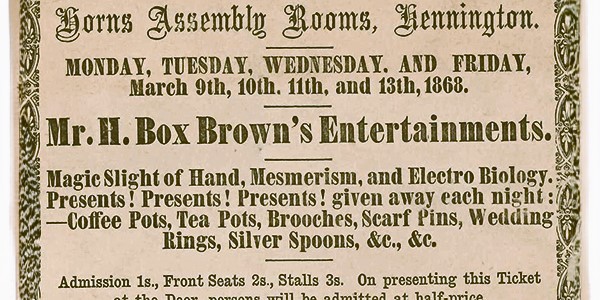
Although mesmerism was popular at the time, Brown used other methods to attract audiences, cultivating a carnivalesque atmosphere at times and luring audiences in with the promise of giving them prizes. On one occasion he is reported to have given a donkey as a gift at the end of the show.[44] After some lectures, Brown gave out smaller, less extravagant prizes, though on at least one occasion he gifted members of the audience a silver watch and a silver teapot, both valuable and desirable items.[45]
It is not possible to know for sure where or why Brown learned magic, but Cutter suggests that he may have learned “conjuring” from another enslaved man whilst still held in slavery. His career as a magician lasted from the mid-1860s until his death, but it seems to have begun whilst he was in Britain during the Civil War, and it really thrived during his time in Wales. Though he was not the only Black American in this time to move towards entertainment as a career, his methods were unique, and challenged and even transcended residual traces of the racialised dynamics of slavery on the popular stage. Not only did his performances, for what were in Britain at the time predominantly white audiences, depart from the standard fare of popular variety and its mix of plantation references in lecture or song, those performances of “mesmerism,” a form of hypnotism, were based on his ability to demonstrate power over audience members and capture their will. There are few details of what exactly Brown had his hypnotized subjects do but certainly, he was turning the white viewer themselves into the entertainment, as Cutter outlines that the tricks typical of mesmerism involved absolute control over the physical and mental power of the audience.[46] However, William Henry Chadwick, a mesmerist Brown worked with, had his subjects go to sleep, jump up on their chairs, ring imaginary bells, stick out their legs, convinced they were sheep, and jump and roll about before being woken up.[47] On one occasion in Merthyr, a disapproving newspaper, referring to Brown in racist terms, notes he displayed “wonderful attractive power,” making audience members “exhibit themselves on the platform in a variety of characters,”[48] and of one of Brown’s performances in January 1867 in Dinas, north-west Wales, a news report notes:
On Saturday the whole evening was devoted to mesmerism and electro-biology. His subjects were taken from amongst the lads of the place, and the things he made them perform while under the odic influence, gave universal satisfaction, and we may characterise them as truly wonderful.[49]
This subversion of racial power, even if in a British rather than American context, may or may not have been obvious to the audience, but its irony could surely not have been lost on Brown, who when enslaved had been subject to the will of white masters, and was now exerting mental and physical power over white subjects and bending them to his own will. His performances occasionally generated controversy, which Brown was quick to shut down. A letter from Brown to the editor of the Monmouthshire Merlin in April 1864, responding to a letter published in an earlier edition, defended his performances against charges of impropriety and cast aspersions on his critic :
Sir – Your paper of the 23rd contains a letter from a Mr. T. J. Wood, in which he states that he attended my entertainment on the Tuesday night previous “with his wife and a lady friend, hoping to see some of the wonderful phenomena produced by the Modern Mesmeriser, but was obliged to leave the room before half the performance was over, in consequence of the vulgarity of the scenes that were performed by one of the subjects under my influence.” Allow me to tell you, sir, that the same gentleman attended my entertainment the night previous, when the same scenes were performed, and he not only expressed himself then perfectly satisfied and amused with the evening’s entertainment, but wished very much to learn the science of mesmerism, provided I could afford to teach it to him for nothing. If it was required, I could comment further on this gentleman, but I think the above will be considered sufficient. By inserting this in your valuable paper, you will oblige, yours, H. B. Brown.[50]
Clearly, Brown’s audiences comprised people from a mix of social classes and sexes, all willing to pay to see him perform and the “science of mesmerism” itself was considered by some a desirable skill to have.
Brown was not afraid to tackle criticism head on, as he did so again in a not at all modest letter to the editor of the Star of Gwent, which had apparently suggested that there was an element of con-artistry at work in the demonstrations of mesmerism:
I not only style myself King of all mesmerisers, but have proved myself to be the most powerful public mesmeriser that ever travelled. I do not choose my subjects, but I mesmerise from my audience, which are from five hundred to one thousand nightly. Therefore, those I have on my platform are truly mesmerised. They do not feign mesmerism, as you represent. Having from twenty to thirty subjects on my platform nightly, there may be, as you state in your paper, “some low bred fellows.” I do not profess to make gentlemen of them the moment I mesmerise them.[51]
Brown, “professor of magic,” continued his work for the remainder of his time in Britain.[52] He appears consistently in Welsh and English newspaper reports until 1874, performing mesmerism, electro-biology, sleight of hand, giving out presents, making boys “seem extremely ridiculous” under his “mesmeric spell,” causing a range of responses between delight and suspicion, but always wonder at his capacity to exert mental control over the subjects form his audience.[53] He returned to the United States in 1875 and settled in Canada with his family in the 1880s, where he continued to perform as a mesmerist, magician, and electro-biologist.[54] There is no definitive evidence that he afterwards returned to Britain, although one newspaper article notes an organ recital by a “Prof Box Brown” in the school of the small village of Varteg, Wales in March 1896, which left a “marked impression on the hearts and minds of the people.”[55] Martha Cutter has noted this appearance and that the location, the warm reception and the performative context do seem to suggest that this may have been Brown.[56] A Jane and Henry Brown can be found on a passenger list for the ship Halifax City, which travelled from London to Halifax (Canada) in 1896 but, as Cutter points out, this is not definitive either as these lists do not contain details that would make identification possible.[57] However, if this was Brown, it would mean his last known performance was in a school in Wales. He died one year later in 1897.
Sayers, Countee and Brown all toured England and Wales extensively in the post-war period, each providing some kind of entertainment to the audiences who continued to attend lectures and other events, if sometimes in smaller numbers than in the antebellum period. Former abolitionists who continued to live and work in Britain in the postbellum period found ways to adapt economically to the changed circumstances for Black lecturers brought by emancipation. Each found their particular niche in the sphere of popular entertainment. Most radically perhaps, Brown, in the town halls and theatres of Wales and England, engaged in a unique and perhaps unprecedented subversion of racial power, emancipating himself from his categorisation as a “former slave” and from the social expectations imposed upon him and other Black entertainers. Becoming entertainers was a method of adaptation, of securing employment and a place in a Victorian society, navigating racial expectations and finding ways to sidestep the rigid class expectations which defined Britain in this time. Exploration of these careers allows for a greater understanding of Black agency within the spheres of public entertainment and art, and contributes to the developing understanding of the roles of Black Americans in nineteenth-century Britain and Ireland.
Notes
[1] R.J.M. Blackett, Building an Antislavery Wall: Black Americans in the Atlantic Abolitionist Movement 1830–1860 (Baton Rouge: Louisiana State University Press, 1983): 2.
[2] Paul Gilroy, The Black Atlantic: Modernity and Double Consciousness (London: Verso, 1993); Vanessa D. Dickerson, Dark Victorians (Champaign: University of Illinois Press, 2007); Alan Rice, Radical Narratives of the Black Atlantic (London: Continuum, 2003); Fionnghuala Sweeney, Frederick Douglass and the Atlantic World (Liverpool: Liverpool University Press, 2007); Fionnghuala Sweeney and Bruce Baker, “‘I am not a beggar’: Moses Roper, Black Witness and the Lost Opportunity of British Abolitionism,” Slavery & Abolition, 2022; Sarah Meer, Uncle Tom Mania: Slavery, Minstrelsy & Transatlantic Culture in the 1850s (Athens: University of Georgia Press, 2005); David Brown, “Duet with John Bull: The Black Abolitionist Mission to the British Isles During the American Civil War,” Slavery & Abolition, December, 2024; Richard Huzzey, Freedom Burning: Anti-Slavery and Empire in Victorian Britain (New York: Cornell University Press, 2012).
[3] Brown, “Duet With John Bull”.
[4] Daphne A. Brooks, Bodies in Dissent: Spectacular Performances of Race and Freedom, 1850–1910 (Durham: Duke University Press, 2006).
[5] Jeffrey Green, Black Americans in Victorian Britain (Barnsley: Pen & Sword, 2018) 81.
[6] William A. Hall, Slavery in the United States of America: Personal Narrative of the Sufferings and Escape of William A. Hall, Fugitive Slave, Now a Resident in the Town of Cardiff (Cardiff, 1862). With thanks to David Wyatt and Bill Jones who provided English translations of much of their Welsh language work on Hall.
[7] “Lecture,” Star of Gwent, March 2nd, 1867, 5.
[8] “Lecture by a Freed Slave,” Weekly Mail, August 16th, 1879, 4.
[9] “Baptist Chapel, Chester Street,” Wrexham Advertiser, October 2nd 1880, 4.
[10] Genevieve Johnson, “‘No Country, No People, Ever Pleased Me So Much’: Black Activists in Wales and Welsh Anti-Slavery Activism in the Nineteenth-Century,” Slavery & Abolition, May 2025.
[11] “Lecture,” The Aberystwyth Observer, March 27th 1875, 3; “Lecture,” The Cambrian News and Merionethshire Standard, April 27th 1874, 5.
[12] “Lecture on Slavery,” Bradford Observer, November 12th, 1872, 3.
[13] “Lecture,” The Aberystwyth Observer, March 27th 1875, 3.
[14] “The Story of an Escaped Slave,” Chatham, Rochester and Brompton Observer, February 12th, 1876, 2.
[15] “Lecture,” The Cambrian News and Merionethshire Standard, April 27th 1874, 5.
[16] “Lecture,” Welshman, February 19th, 1875, 5.
[17] “Lecture,” 3.
[18] Green, Black Americans, 42.
[19] All biographical details found at the Serendipity Institute for Black Heritage, who have carried out extensive work on Countee and his descendants. No images of Countee survive, if indeed they ever existed, but an exhibition was held about him and his British descendants at Leicester Museum and Art Gallery. “The Countees of Leicester,” Serendipity Institute for Black Arts and Heritage; Green, Black Americans.
[20] “Sisters of Progress,” South London Chronicle, January 20th, 1866, 5.
[21] “Salvation Army,” Illustrated Berwick Journal, April 16th, 1885. He had three daughters, Lucy, Mary Ann, Ame.
[22] “Special Services,” Monmouthshire Merlin, January 25th, 1881, 5; “Darlith (Lecture),” Y Tyst a’r Dydd, February 1st 1884, 2.
[23] “Story of a Fugitive Slave,” Monmouthshire Merlin, May 28th 1880, 8.
[24] “Lecture at the Court House,” Warwick and Warwickshire Advertiser, October 13th, 1867, 2.
[25] “Story of a Fugitive Slave,” 8.
[26] “1891 England, Wales & Scotland Census.” Find My Past. Accessed February 3rd, 2026.
[27] All information on the Countees gathered from the Serendipity Institute for Black Heritage.
[28] Henry Box Brown, Narrative of the Life of Henry Box Brown, Written by Himself. Documenting the American South. Accessed February 8th, 2026.
[29] Frederick Douglass, My Bondage, My Freedom (New York, 1855), Project Gutenberg.
[30] Martha Cutter, The Many Resurrections of Henry Box Brown (Philadelphia: University of Pennsylvania Press, 2022).
[31] Martha J. Cutter, “Will the Real Henry ‘Box’ Brown Please Stand Up?” Common Place 16, no. 1, 2015.
[32] Jeffrey Ruggles, The Unboxing of Henry Box Brown (Richmond: Library of Virginia, 2003); Brooks, Bodies in Dissent; Marcus Wood, “‘All Right!’: The Narrative of Henry Box Brown as a Test Case for the Racial Prescription of Rhetoric and Semiotics,” American Antiquarian Society: A Journal of American History and Culture, no 107 (1998): 65-104.
[33] Green, Black Americans, 15.
[34] Brooks, Bodies in Dissent, 121.
[35] Cutter, “Will the Real Henry ‘Box’ Brown Please Stand Up?”; Cutter, The Many Resurrections of Henry Box Brown, 186.
[36] “Mesmerism,” Oxford Times, October 12th, 1867.
[37] Cutter, The Many Resurrections of Henry Box Brown, 157.
[38] There is surprisingly little recent scholarship in the field of history on mesmerism itself. The best sources which are not from medical journals come from Terry Parssinen’s work in the 1970s, particularly Terry Parssinen, “Popular Science and Society: The Phrenology Movement in Early Victorian Britain,” Journal of Social History 8, no. 1 (1974): 1–20 and Terry M. Parssinen, “Mesmeric Performers,” Victorian Studies 21, no. 1 (1977): 87–104.
[39] Parssinen, “Mesmeric Performers”.
[40] Bram Stoker, Dracula (Wordsworth Classic Editions, 1993).
[41] Johnson, “‘No Country, No People, Ever Pleased Me So Much’”.
[42] “Robbery at a Sailor’s Home,” Swansea and Glamorgan Herald, December 5th, 1863, 8. The lack of detail about Brown’s activities in this article is due to the fact that he is mentioned only as a witness in a legal case – his work is not the focus here.
[43] “Mesmerism,” The Cardiff and Merthyr Guardian Glamorgan Monmouth and Brecon Gazette, August 12th 1864; “Mesmerism,” The Illustrated Usk Observer and Raglan Herald, 26th March 1864.
[44] Cutter, The Many Ressurections of Henry Box Brown, 161.
[45] “Mesmerism,” The Cardiff Times, January 12th 1867, 7.
[46] Cutter, “Will the Real Henry Box Brown Please Stand Up.”
[47] Cutter, “Will the Real Henry Box Brown Please Stand Up.”
[48] “Mesmerism,” Western Daily Press, February 22nd, 1864, 3.
[49] “Dinas,” The Cardiff Times, January 16th 1867.
[50] No title, Monmouthshire Merlin, 30th April 1864.
[51] “Mr. Box Brown’s Entertainment. To the Editor of the Star of Gwent,” Star of Gwent, April 30th, 1864, 6.
[52] “Entertainments,” Rochdale Observer, September 5th 1874, 8.
[53] “Mr Box Brown’s Entertainments,” Hampshire Telegraph, September 11th 1869, 4; “Mesmerism,” Oxford Times, October 12th 1867, 6; “Henry Box Brown,” Rochdale Observer, March 12th, 1870, 7.
[54] Cutter, “Will the Real Henry ‘Box’ Brown Please Stand Up?”
[55] “Varteg,” Pontypool Free Press, March 20th, 1896.
[56] Martha Cutter, The Many Resurrections of Henry Box Brown, (Philadelphia: University of Pennsylvania Press, 2022): 215.
[57] Cutter, The Many Resurrections, 215.