

IJAS Special Issue: New work in 19th-Century Historical and Literary studies
Introduction
A few years ago, while conducting research in the American Antiquarian Society (hereafter AAS) for my book Antislavery in the Dissenting Atlantic: Archives and Unquiet Libraries (2025), I spotted an intriguing catalogue reference to “The Circulating Library”, a lithograph printed in Baltimore in 1831. At the time I was reading a good deal about real and fictional libraries, but in addition to the obvious relevance of its title, the lithograph’s date and geographical origin also piqued my interest. They reminded me of one of the most famous moments in the early biography of Frederick Douglass that took place at that time in Baltimore, namely his illicit purchase of Caleb Bingham’s The Columbian Orator (1797) from Thomas Knight’s bookstore at 28 Thames Street, Fells Point. The volume substantially expanded his precious personal library comprised of the newspapers and other works he secreted within the loft in the household of Hugh and Sophia Auld where he initially lived between 1826 and 1833. The formerly enslaved boy would go on to become an avid bibliophile with a huge personal library in his final home at Cedar Hill in Washington, D.C.. Details of the purchase are compellingly described by David Blight who also notes that Abraham Lincoln purchased a copy of the volume around the very same time.[1] The two men’s purchases cut across region and race, enslavement and freedom, connecting and bringing into a readerly relationship two towering American figures across the colour line, anticipating W.E.B. Du Bois’ statement “I sit with Shakespeare and he winces not. Across the color-line I move arm-in-arm with Balzac and Dumas.”[2] Yet of course in practice there have always been constraints to accessing books. Though Knight’s shop was close to Henry Colburn’s short-lived circulating library at 23 Thames Street[3] one of several circulating libraries in Baltimore, none of these were accessible to the enslaved boy who longed to read.
These contextual details connected the as-yet unseen lithograph to strands of my work-in-progress, namely the rise in rates of literacy and the expansion of a transatlantic, cross-class and cross-race reading commons despite the exigencies of slavery, including the brutal enforcement of prohibitions on literacy learning.[4] As I went on to argue in the book, abolitionists made use of the development of mass print, but their activism also comprised multiple quotidian moments and acts of ethical activist opportunism using whatever came to hand – carving on rocks, subverting the census through guerrilla inscription, adapting texts on embroidered samplers to make new meanings. They understood the power of books and texts that were often hard to access, and used ingenuity and creativity to achieve their political ends. Putting in an order form, I returned to my work. I supposed that the print would be an interesting distraction, but perhaps little more. I was wrong.
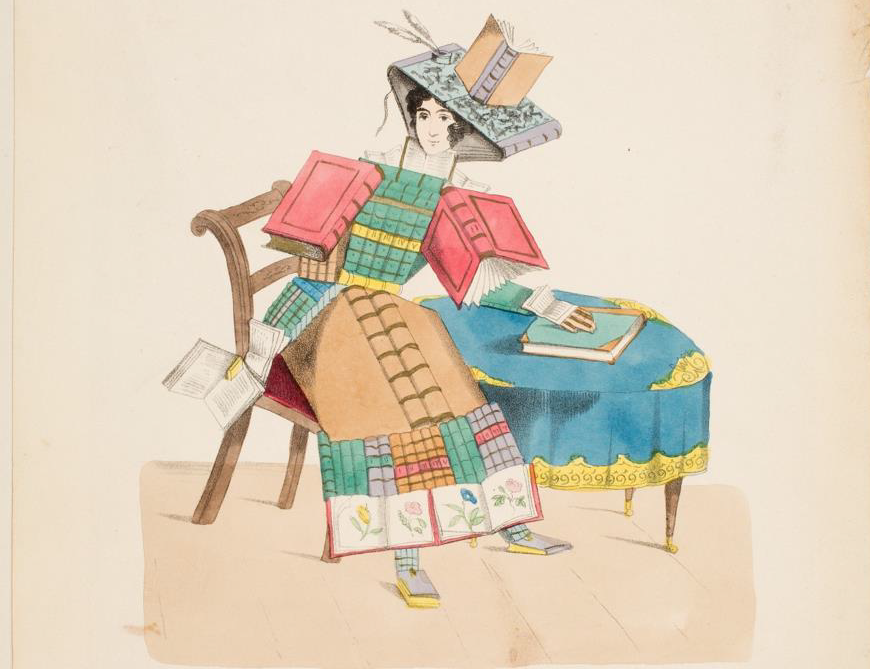
When the archivist brought the lithograph to my desk she said, “You’re going to love this”. Immediately opening the slim package, I encountered an intriguing, clever, and unsettling personification portrait depicting a fashionable young white woman made from a set of volumes of varied sizes, all imaginatively adapted from their intended use. The lithograph is part of a burgeoning domain of nineteenth-century transatlantic print. Though the specific object I encountered was printed in Baltimore, its origins were in London. “The Circulating Library” is one of a series of playful and attractive personification images produced by George Spratt, a British artist, illustrator and printer who was also a member of the Royal College of Surgeons and a highly regarded male midwife. The woman in the image is not only crafted from books, but she is also a reader and since she has the tools she needs for writing, she is also presumably a writer. When I first saw her, I had an unanticipated sense of identification; for all of us in the reading room that day were also made of books. The print is ingenious and witty, made more compelling by a simple colour palette that harmoniously brings together its varied parts. Shaped by a knowing self-referentiality, it emerges from a particular moment in the development of libraries and mass print. It codifies familiar knowledge about the main users of circulating libraries who were, like the woman in the lithograph, white women enjoying new access to printed matter. Yet by challenging expectations through its ingenious use of books, it also stages a paradox, suggesting and licensing the unorthodox possibilities of book objects. The archivist’s assumption that my encounter with “The Circulating Library” would have an emotional impact was indeed spot on. I decided that at some point I would write about its complexities, and though I have been thinking about it since that day I am only writing about it now, after several years.
Books and other kinds of printed matter are often represented in nineteenth-century texts, including within the book object itself or in visual texts such as the lithograph which playfully works with books. The image is characterised by its maker’s knowing repurposing of a history of visual representation; specifically, it invokes Giuseppe Arcimboldo’s The Librarian (1566), which depicts a male librarian comprised of books.[5] It is the consequence of careful reflection leading to the multiple and unexpected interpretive possibilities material objects always carry. Writing of the complexity of the nineteenth-century book as an object of study, Leah Price identifies three overlapping “operations” governing the use of books and printed matter: reading, handling and circulating.[6] Book objects and printed texts can pass through many hands and end up in libraries awaiting readers or they can have any number of other unintended uses, as Price eloquently shows. The lithograph accommodates the possibilities identified by Price; the woman is not just handling and reading books but personifies circulation. As a transatlantic print object representing books in a multifaceted manner, “The Circulating Library” also epitomises a mobility beyond its overt representational codes and draws attention to the potential of unexpected uses, and interpretations, of books. In the period in which it was produced, a highly connected commercial network of writers, editors, printers, and booksellers governed the world of transatlantic print. Through circulation within this network, books and printed matter developed additional impact and unlikely afterlives. Their fugitive meanings[7] exceed the intentions of their creators and emerge only through the contingencies of archival survival, scholarly attention, and the affective charge of encounters, such as the one I experienced. Produced by material and historical wanderings, such meanings are made legible at the very moment of encounter as objects and texts slip between contexts and evade singular interpretations or readings, revealing their waywardness. Objects are always imbued with such movement and require methods capable of attending both to the unruliness of their material lives and the affective response they provoke.
In this essay I reflect on the lithograph’s status as a material object depicting imagined books being read, handled and circulated by a newly-empowered readership. The lithograph carefully represents various potential uses of nineteenth-century books, at the same time as responding to a major cultural and social shift. I seek to recover and explore an occluded transatlantic history of mobility showing that its history complicates its meanings as it migrates across and between (or circulates within) interpretive communities, geographies and sites including the archive where I encountered it. Of course, archival encounters with mobile objects require methods that are themselves on the move. Recent scholarship across a range of distinct areas has made clear that since archival encounters are never neutral, scholars need to keep developing analytical and methodological tools to understand what is in the archive and what remains outside, how archives are created, and by what means encountered objects can most fully be interpreted and understood. Saidiya Hartman and Marisa Fuentes have both demonstrated how the archives of slavery are structured by violence, silence, and loss, requiring methods such as critical fabulation to attend to what is missing as much as to what survives. Tina Campt urges us to “listen” to archival objects for the quiet, affective frequencies they emit and enable the “endlessly generative space of the counterintuitive.”[8] The work of these and other scholars, along with Michel‑Rolph Trouillot’s foundational account of archival silencing and Christina Sharpe’s insistence on reading “in the wake” of racial violence, show archival methodologies shifting toward interpretative practices that acknowledge emotion, embodiment, and the uneven distribution of visibility and legibility.[9] My reading of the lithograph exists within an explanatory structure made possible by such methodologies and is itself characterised by a deliberate wandering beyond the framework of the image. I first focus on the historical and commercial contexts within which the lithograph emerged. Expanding the range of reference, I explore examples of three enslaved readers or would-be readers who were not within the lithograph’s imaginary realm, but who each also understood the possible uses of book objects and print. My essay seeks to reframe print culture as a technology of possibility. It shows how people denied power could nevertheless use texts to imagine alternative futures, and it encourages us to understand archives not as closed records of what was, but as ongoing sites where new knowledge, histories, and freedoms can still be made.
Taking fugitive meaning-making at face value, I show the ways that Frederick Douglass, Harriet Jacobs and Thomas Jones all repurposed encountered texts to create their own meanings, enabling movement from Southern enslavement to Northern freedom. Douglass and Jones separately and ingeniously purchased longed-for books, and adapted their book knowledge to emancipate themselves and write about their emancipation. What they gained from their purchases in Baltimore and Wilmington (respectively) was not just the comprehension acquired from learning to read and write, but an understanding of the power of disobeying injunctions in order to challenge the ideological and legal constraints on their personhood. Harriet Jacobs, already a reader, took what appears to be ephemeral waste matter in the form of a discarded pro-slavery newspaper, turning it into a vital emancipatory tool. All three creatively engaged with texts, a powerfully political action, carefully assuring their invisibility at the time of their actions though making themselves visible to us who are able to see them through the consequential nature of their deeds. What this demonstrates is that archives, books, and print culture are not static records of the past but are mobile and contested sites of knowledge production, enabling enslaved people in particular to generate new forms of meaning, mobility, and freedom. Douglass, Jacobs and Jones — all writers in the making — refused their assigned positions as they reached across the colour line and took up the texts they then used to imagine, and create, future lives. Both as material objects and as imaginative and intellectual resources, printed texts accrue unfixed and changing afterlives that exceed or even overwhelm and repudiate their anticipated purposes, as they circulate beyond their point of origin and move across geographies and temporalities. In consequence, they empower us to seek out unanticipated consequences, making new meanings and understanding the archive as a site of ongoing and generative knowledge.
“The Circulating Library”
 The circulating library. [graphic] / Lith. of Endicott & Swett.[Baltimore]: Published by J.N. Toy & W.R. Lucas Balto., [1831] Courtesy, American Antiquarian Society.
The matter of both the archive and the library was very much in my mind as I undertook research for my book. Though I started working on it in 2020, the Covid pandemic immediately put paid to most of my plans, ultimately reshaping the book itself. Unable to travel, with archives and libraries largely closed, I often despaired about whether it would be possible to write it at all. But I plodded on, greatly assisted by the knowledge and skills of the archivists and librarians who made materials available electronically and assisted in countless other ways. As restrictions were lifted, I started to make research trips, initially within the UK though eventually I was able to travel to the US. I steadily produced a manuscript and had it accepted by a publisher. However, when the final revisions to the manuscript were taking place and I was reliant on the resources of the British Library, the library was subjected to a major and extremely damaging cyber-attack. The difficulties I had repeatedly experienced when trying to access archives and libraries during varied periods of crisis gave me added food for thought, changing the ways my argument developed as I found myself frequently frustrated by lack of access to the books I needed. During my time in the AAS I was investigating access to, and exclusion from, libraries, exploring how the figures I was studying – chiefly African Americans, nonconformists and women – founded their own reading rooms and libraries.[10] While libraries are often sites of possibility, opening up book-reading to new readers, in the nineteenth century books and print remained beyond the reach of many, especially the enslaved. Throughout the intensive period of research, I read about a range of libraries and their historical development including two subscription libraries that were key to my work, the Library Company of Philadelphia and the Leeds Library. In addition, I reflected on different kinds of libraries and readers, encompassing the rise of circulating libraries, commercial enterprises, run for profit.[11] During this development some celebrated the democratization of reading and the creation of new communities of readers across existing boundaries, while others were profoundly anxious that the women whose lives were changed in consequence to their new access to books and reading would be distracted from their proper duties and would waste their time reading novels (a genre particularly matched to such libraries). Meanwhile, publishers seized the opportunity to reshape the novel in line with the possibilities afforded by circulation; triple decker novels were ideally suited to their modus operandi.
It was during a period of library-focused reading that the lithograph was brought to my desk. At first, I read the numbers on the volumes and tried, unsuccessfully, to see whether there was legible writing on the open pages of books, attempting to read the lithograph as if it was itself a book rather than a playful representation of what can be done with books. I started to look at it once more, scanning the woman from the head downwards. She wears a head covering comprised of a total of three books. Two of them are identically bound with embellished covers, which are angled to frame her face. Sitting atop them are two decorative items, another volume, opened on its side with its spine facing forward, and an ink stand containing two quill pens, like the decorative feathers on a fashionable bonnet. The pages of the volume form a fan-shaped embellishment so that anyone standing behind her would be able to see into the pages of the volume. Provokingly, though, this book faces away from viewers, making any contents a matter of speculation. Though the feather quills are static, they could be taken up at any time and perhaps even used to write upon the pages of the volume next to them, for after all, it might be a diary or commonplace book, waiting to be filled. But, as a reminder that books are chiefly intended to be containers of words, sometimes printed, the woman’s collar, cuffs, and the book she holds in her right hand are all made up of open books, clearly revealing the print within them while obscuring the individual words. She is so “bookish” that her head is the only part of her not made up of the pages or covers of printed volumes. Moving downwards, her neck and shoulders are fashioned from the open pages of books, their printed words showing, though unreadable. From her shoulders to her elbows are two large, red, numbered volumes. Her right arm, Volume One, is closed. Her right hand holds another book with its pages open as if she has just been reading, suggesting a present-time engagement. The pages of her left arm, Volume Two, fall open as she stretches her arm across the table to rest upon a closed book on the table next to her showing that there is still more to read on the pages that can open to her touch. The cuffs of her long sleeves are themselves the open pages of small books, too large to be miniatures but very different in scale to the single substantial volume making up the skirt of her dress. The sequence of books is repeated on the first part of the flounce or hem of her dress while a second layer reveals four open pages, each decorated with a single flower. These add to the sense that she is a woman of fashion, whose stylish clothes would not be out of place in the pages of one of the many literary annuals flourishing in the period.
The best-known of these, Godey’s Lady’s Book, was first published in 1830 in Philadelphia and was widely admired for its use of hand tinted fashion plates. Like other literary annuals, it was also a platform for women’s writing. The woman personifying “The Circulating Library” (a figure easily imaginable in a literary annual) is configured from and shaped by books just as the women who bought literary annuals in huge quantities were formed by their reading. Her ankles, each made of a sequence of four books with the spines facing out, are attached to tiny feet that do not look likely to support her well. Though she personifies a circulating library it seems unlikely that she would actually be able to move confidently. Since she is seated, she does not immediately have to worry about such a prospect. Indeed, nothing seems to worry her. Her gaze is directed over the left shoulder of the viewer, while her face remains impassive. Yet, taken as a whole, the image reflects the circulation of objects, ideas and people in the global nineteenth century. For instance, the chair on which she sits is upholstered in red material, perhaps damask or velvet. The inlaid decorative wood on the frame indicates that the chair is of high quality, likely mahogany, and therefore has an unspoken relation to histories of slavery, environmental destruction and colonial violence.[12] The sense of luxury produced by these rich colour tones is amplified by the heavy blue tablecloth on the table next to her. Gold edging embellishes the cloth as it meets the perimeter of the table and then decorously covers the slim table legs, carefully and modestly hidden like the legs of the woman. Combining utility with display, the edging echoes the colouration of the small castors on the table legs. They ensure that table is not restricted to a single location; it can be circulated within the room to facilitate varied activities and take advantage of the light. Movement is built into the image in all these varied details, suggesting diverse kinds of circulation. And the image undoubtedly circulated.
Its creator George Spratt was part of the commercial landscape of print with a detailed knowledge of traditions of representational art. He had an artistic and business alliance with two other men – a printer called George Madeley and a bookseller, Charles Tilt. Beyond this triangular collaboration, the print would also have been through the hands of many anonymous figures throughout its transatlantic circulation, including figures who made paper or inks or paint, and others who hand-coloured prints. We know little of those whose expert skills went into producing the lithograph but can assume that those who were London-based would have been paid, though their skills probably had slight remuneration. Their equivalents in Baltimore might also have been waged labourers or might have been part of an enslaved workforce providing labour in print works and bookstores.[13] Just as the conditions within which they conducted their labour on either side of the Atlantic would have differed, each print varies slightly, producing distinct meanings, and suggesting the expansive imaginative possibilities of encounters with mass-produced print. While the chair in the AAS print is upholstered in red, a London variant features blue upholstery – perhaps the consequence of personal choice or available pigments.
George Spratt did not limit himself to quirky personification images. Shortly after the appearance of the lithograph he produced an influential teaching book titled Obstetric Tables (1833).[14] This brought his artistic and medical skills together, showing evidence not just of firsthand medical knowledge but once again of familiarity with the traditions of earlier representational visual culture. Anatomical flapbooks were pioneered by Andreas Vesalius in his seminal work De Humani Corporis Fabrica Libri Septum (1543). With the advent of flapbooks, unruly three-dimensional human bodies were disciplined and scrutinized, made to conform to uniform templates and epistemes, explored while rendered static. The messiness of blood was captured and contained in images of the circulatory system, showing it being carried to every part of the body. The flapbooks incorporated movement using ingenious methods. Moveable sheets, or fugitive sheets as they were called, enabled an examination of the body as if through dissection, giving depth to two-dimensional images. In this way, readers (often students) were given access to the construction of the human form. [15] Given their physical structure and delicate and fragile connection to the full page, the fugitive sheets were easily torn and often went missing – hence their name. They were designed to enable controlled movement, though not the kinds of unexpected circulation produced when they became disconnected from books. The sheets epitomized the mobility, elusiveness and transience associated with fugitivity as well as the possibility of being imbued with context-dependent new and different meanings.
The other two main figures involved in the collaboration were, like Spratt, commercially savvy and understood the market well. George Madeley’s oeuvre encompassed satirical works, sheet music, portraits of theatrical figures in character, landscapes, and portraits of topical figures — some held in high esteem and some infamous. Meanwhile Charles Tilt had a lifelong association with the book trade, starting with a six-year apprenticeship to a bookseller in Hampshire between 1811 and 1817. Moving to London, he honed his skills at two well-known firms, Hatchards, and Longman and Co. He then branched out independently, starting his own business in 1826 at 86 Fleet Street, where he remained for the rest of his career. His premises were close to those of Madeley, whose own business operated just off the Strand, on 3 Wellington Street, from 1829 until 1858. Tilt had a well-developed understanding of the symbiotic relationship between the curation of enticing visual displays and cultivation of appealing profit margins.[16] Literary annuals were particularly suited to both these purposes — they had enormous circulation numbers and were profitable enterprises visually characterised by decorative covers and further made appealing to their (chiefly female) readers by substantial quantities of illustrations. In short, the commercial practice of printing attractive books and curating compelling shop window-dressings connected the mass production of print to visual aesthetics. Crowds would gather outside Tilt’s shop to look at carefully orchestrated displays designed to pull in punters and sell his wares. The beguiling windows were designed to attract viewers across the spectrum of literacy skills, and also to be of interest to non-readers as well as those who could not afford to buy the items he displayed but who could enjoy the spectacle itself, at no cost. It is easy to imagine “The Commercial Library” in a shop window, delighting window shoppers.
Book stores, print shops and window displays
Two commercially savvy nineteenth-century authors, one American and one British, give good accounts of the relationship between booksellers’ increasing use of window displays. A carefully-observed fictional account of the mid-century literary marketplace is found in Fanny Fern’s (Sara Payson Willis’) lively semi-autobiographical novel Ruth Hall (1855). The difficulties encountered by the protagonist after the death of her husband Harry see Fern putting her personal experiences of breaking into print to good use, showing how a struggling widow became a best-selling author. In doing so she also paid back those who had treated her badly in a set of sharply written depictions of characters based on real-life figures. These included her brother, Nathaniel Willis Parker, then a well-known author whose fame now chiefly rests on his relation to Harriet Jacobs, who secretly wrote Incidents in the Life of a Slave Girl (1860) while working in the Willis household. Like Ruth, Fern was widowed while she was a young mother and had to manage a series of jobs prior to her success as a writer. She quickly learned how to navigate the various elements of the period’s highly commercial print culture, engaging with male editors, publishers and booksellers to get her work published. In a passage describing the shop window of a morally ambivalent bookseller, Thomas Develin, Fern drolly notes that his poor taste and religious pretensions are echoed in the displays themselves: “His windows were adorned with placards of the new theological publications of the blue-school order, and engravings of the departed saints….There was, also, to be seen there an occasional oil painting…with a peculiar eye to the greenness of the trees, the blueness of the sky, and the moral ‘tone’ of the picture.”[17] Her acidic reflections reveal her understanding that some books were commodity objects chiefly intended to be handled, circulated and displayed: they should be like well-behaved nineteenth-century children, seen and not heard (or read).
On the other side of the Atlantic, Charles Dickens was an avid window shopper in the print hub of the Strand and Fleet Street where Tilt’s shop was located. In an essay published in Household Words in April 1851, he described the way his pleasure at looking at prints in a window was further enhanced by the appearance of a group of urchins whose own apparent attention to the window delighted him. Shortly afterwards, he realised that they had robbed him. They were a gang of pickpockets, reading the crowd for potential victims and taking advantage of the distracting displays.[18] Dickens’ work draws attention to who likely constituted ideal readers/patrons and who did not, suggesting prevailing assumptions about gender, literacy and race that are also silently evident in “The Circulating Library”. Drawing upon a legacy of representational art, Spratt’s lithograph incorporates a set of visual conventions that are specific to its time and place, signifying historically contingent assumptions about library patrons and literacy. Its whimsical surface belies the racialised and gendered exclusions it silently reinforces; Douglass (who counted Dickens as his favourite author) cannot be imagined within its visual codes.[19] Nor, indeed can Jacobs and Jones, the other enslaved figures whose narratives I was reading around the time I first saw the print. Yet all three had profound interactions with print objects that they found ingenious ways of appropriating and adapting for new (even unanticipated) uses, in a manner similar to the way Spratt adapted books for his lithograph. In the last part of this essay I turn to the ways they also engaged with nineteenth-century printed objects, starting with Frederick Douglass’ well-known description of his purchase of The Columbian Orator, a key moment in the Narrative of the Life of Frederick Douglass, an American Slave (1845).
Who’s not in the picture?
In a frequently quoted passage, Douglass writes simply, “I was now about twelve years old, and the thought of being a slave for life began to bear heavily upon my heart. Just about this time, I got hold of a book called ‘The Columbian Orator.’ Every opportunity I got, I used to read this book.”[20] He adds some further detail in subsequent descriptions of the purchase, though his chief focus is always on its life-changing consequence rather than the actual experience of encountering and buying the volume.[21] His focus is on what it does to, and for, him, rather than an emotional epiphany of the kind invoked in John Keat’s “On First Looking into Chapman’s Homer” (1816) for instance, though it was undoubtedly an epiphanic moment of far greater consequence. The book taught him about how to construct persuasive arguments, and to see the connection between apparently distinct social justice and global struggles. Douglass valued it so much that it was the earliest purchase in what would become his substantial personal library, carrying it with him when he made his way into freedom. Engaging with the book enabled him to perceive the powerful connection between literacy and empowerment, one he would continue to advocate throughout his activist life. As I sat in the reading room looking at the lithograph, I found that my own reflections on the emotional impact of my archival encounter made me wonder about how Douglass navigated the immediate emotional impact of this celebrated event. What were his feelings as he approached the shop? Did he have to ask for the book or was he able to take a copy off a shelf? Did he wish to browse among the other volumes on display? Indeed, were there volumes on display either within the shop or in its windows? Knowing the dangers of being an enslaved person seeking to buy a book, did he get in and out of the shop as quickly as possible? Douglass says tantalisingly little about this life-changing moment, as do his biographers. But he knew that he wanted to make himself out of books and was determined to get access to a book of his own. Trying to reflect upon the scene of Douglass’ encounter with a longed-for book, I turned instead to the 1850 edition of the narrative of Thomas Jones, published by the Black printer Daniel Laing in Worcester, where the AAS is located. This contains a powerful and detailed account of his childhood experience of illicitly purchasing a book in Wilmington, North Carolina. Deciding first to ask David Smith, the editor of the Cape Fear Recorder for assistance, Jones writes,
I went one morning, with a beating heart, into his office, and asked him to sell me a spelling-book. He looked at me in silence, and with close attention, for some time, and asked me what I wanted. I told him I wanted to learn to read. He shook his head, and replied, “No, Thomas, it would not answer for me to sell you a book to learn out of; you must not learn to read; you will only get yourself into trouble.” [22]
He next approached Smith’s brother Peter who “kept a book and stationery store under the printing office” but this time he told him he had been asked to buy it for a white boy:
The book was then handed out to me, the money taken in return, and I left, feeling very rich with my long desired treasure. I got out of the store, and, looking round to see that no one observed me, I hid my book in my bosom, and hurried on to my work, conscious that a new era in my life was opening upon me through the possession of this book. That consciousness at once awakened new thoughts, purposes and hopes, a new life, in fact, in my experience.[23]
Jones’ description, unlike that of Douglass, is almost entirely focused on the emotional experience of handling his purchase for the first time. Identifying David Smith, a printer, newspaper editor and “very kind man”, he experiences fear and anxiety, his “beating heart” eloquently indicating the psychological and physiological strain of the encounter. There are obvious parallels between the accounts of Douglass and Jones, but where they differ is in Jones’ focus on the powerful emotions associated with the moments leading up to the purchase and immediately following his success. At the same time, Douglass would undoubtedly have found Jones’ account recognisable.
The consequence of Douglass’ audacious act was the production of a set of expansively described fugitive meanings. In the passages leading up to the purchase and in the immediate aftermath he focuses on what has led him there, namely the weighty knowledge of his enslavement and the belief that literacy will give him a route into freedom. Having initially imagined himself being able to read like the real white boys he encountered in Baltimore, he envisages himself being able to argue like the fictional slave he encountered in The Columbian Orator, “I could not help feeling that the day might come, when the well-directed answers made by the slave to the master, in this instance, would find their counterpart in myself.”[24] He celebrates the emancipatory possibilities of oracy, reading and print, something that was extremely familiar to Harriet Jacobs, to whom I turn in closing.
While hiding in her loophole of retreat in her grandmother’s house in Wilmington, North Carolina, Harriet Jacobs/ Linda Brent made ingenious use of a part of the pro-slavery New York Herald, repurposed by an itinerant peddler to wrap a cap that had been purchased by her friend Peter. Saving the encircling newspaper, he gave it to Linda (while presumably keeping the cap). The newspaper was initially circulated to its intended readers and then a part of it was recirculated twice more in the form of a fugitive sheet, first as wrapping and then as a source of vital antislavery intelligence. Through careful study Jacobs was able to learn the names of New York streets. Armed with this information she then wrote letters from her hiding place as if she had already fled from enslavement to freedom in New York. In this manner she created new and different forms of circulation, performing a mobility that she did not yet possess but would first invent and then inhabit. She protected herself in her hiding place and created a mobile avatar that she sent off to New York. This fugitive alter ego enacted a life in freedom that she would go on to seize in person. As Stacey Margolis puts it, “Linda, hidden in a garret, writes letters that circulate from hand to hand, get rewritten, recited to the family, and spread gossip and rumors about her whereabouts.”[25] Presumably the fugitive sheet, wrapped around the circular cap and then perused so assiduously by the enslaved Linda, has an intended readership comprised of whites sympathetic to its pro-slavery stance. It gains unanticipated power through circulation and fugitive meaning-making by a reader outside of its imagined realm opportunistically seizing the chance of freedom. Linda uses it for counter-surveillance and self-fashioning, including claiming freedom for herself and for her children. In this way, the newspaper that is waste matter accompanying the purchase of a cap becomes more important than the purchase. Her focus on making new and transgressive meanings shows her understanding of the way she could press the newspaper into service against the ideological interests of its readers, publishers and writers. She writes knowingly, “for once, the paper that systematically abuses the colored people was made to render them a service.” [26] At the same time, since a newspaper’s circulation figures are made up of the copies distributed rather than read, Linda remains invisible, uncounted and unaccounted for in its taxonomic framework just as she is within the codes of “The Circulating Library”. Unseen, uncounted, yet subversively and triumphantly present, Linda/Jacobs adapts the print she encounters and imaginatively recreates new emancipatory possibilities. The names that mark fixed New York locations are unfixed by her, finding the way to and from her grandmother’s house, where she waits and projects an activist future beyond its confines.
The imaginative ways in which books and printed texts were appropriated by Douglass, Jacobs and Jones lay bare the purposeful creativity of all three individuals. Refusing to acknowledge their place within a white supremacist ideology that figures them as being acted upon rather than acting, they actively reconfigure themselves within codes of readerly comradeship and knowledge, using the resources of encountered texts. Just as Spratt’s image personified the circulating library as female and white, imagining the new readers and possibilities that circulating libraries nurtured, these examples show three readers or would-be readers imagining and appropriating opportunities to fashion transgressive meanings and shape possible futures. To follow the movements of books, readers, and meanings as I have sought to do here is to recognise that neither texts nor archives are ever settled: both remain sites of possibility, continually generating new histories, new understandings, and powerful new freedoms.
Notes
[1] David W. Blight, Frederick Douglass: Prophet of Freedom (Simon and Schuster, 2018), 61-72.
[2] W.E.B. Du Bois, The Souls of Black Folk, with an introduction by Donald B. Gibson and notes by Monica M. Elbert (Penguin Books, 1989), 90.
[3] Joseph Lawrence Yeatman, “Literary Culture and the Role of Libraries in Democratic America: Baltimore, 1815-1840,” Journal of Library History (1974-1987) 20, no.4, (1985): 345-67, 352. Yeatman also draws attention to several successful Baltimore circulating libraries. See also Larry E. Sullivan, “The Reading Habits of the Nineteenth-Century Baltimore Bourgeoisie: A Cross-Cultural Analysis,” 16, no.2, (1981): 227-240. Lawrence Jackson shows the ways Douglass’ intellectual and political consciousness were shaped by the Black population of Baltimore. See, Lawrence Jackson, “Baltimore” 9-20 in Frederick Douglass in Context edited by Michaël Roy (Cambridge University Press), 2021.
[4] Jennifer Monaghan’s work on the relationship between reading and writing remains foundational. See E. Jennifer Monaghan, “Reading for the Enslaved, Writing for the Free: Reflections on Liberty and Literacy,” Proceedings of the American Antiquarian Society 108, no.2 (1998): 309-341.
[5] Work I have found helpful includes K.C. Elhard, “Opening the Book on Arcimboldo’s Librarian,” Libraries and Culture 40, no.4 (2005): 115-127; Elhard, “Reframing Arcimboldo’s ‘Librarian,’” Library History 22, no.3 (2006): 181-199.
[6] Leah Price. How to do Things with Books in Victorian Britain (Princeton University Press, 2013), 10.
[7] The language of fugitivity is widely used adjectivally, but Elaine Freedgood’s 2006 use of the term is one that is useful to me in this essay. Elaine Freedgood, The Ideas in Things: Fugitive Meaning in the Victorian Novel (University of Chicago Press, 2006), 4.
[8] Tina M. Campt, Listening to Images (Duke University Press, 2017), 6.
[9] Saidiya Hartman, Scenes of Subjection: Terror, Slavery, and Self-Making in Nineteenth-Century America (Oxford University Press, 1997) and “Venus in Two Acts,” Small Axe 12, no.2 (2008): 1-14; Marisa J. Fuentes, Dispossessed Lives: Enslaved Women, Violence and the Archive (University of Pennsylvania Press, 2016); Michel-Rolph Trouillot, Silencing the Past: Power and the Production of History (Beacon Press, 1995); Christina Sharpe, In the Wake: On Blackness and Being (Duke University Press, 2016); Illaria Scaglia and Valeria Vanesio (eds.), Archives and Emotions: International Dialogues Across Past, Present and Future, (Bloomsbury Academic 2025).
[10] See, in particular, Elizabeth McHenry, Forgotten Readers: Recovering the Lost History of African American Literary Societies (Duke University Press, 2002).
[11] For more on circulating libraries and their catalogues see Edward H. Jacobs, “Eighteenth-Century British Circulating Libraries and Cultural Book History,” Book History 6 (2003):1-22.
[12] See Elaine Freedgood’s reading of the mahogany furniture in Jane Eyre. Freedgood, Ideas in Things, 30-54.
[13] Leon Jackson notes that on visiting a bookstore in New Orleans in the 1840s, Thomas Low Nichols was surprised that the owner’s highly knowledgeable employee was an enslaved man. Leon Jackson, “The Talking Book and the Talking Book Historian: African American Cultures of Print – the State of the Discipline,” Book History 13 (2010): 251-308, p.280
[14] George Spratt, Obstetric Tables: Comprising Coloured Delineations on a Peculiar Plan, Intended to Illustrate Elementary and Other Works on The Practice of Midwifery, Elucidating Particularly the Application of the Forceps, and Other Important Practical Points in Obstetric Science (Churchill, 1833). The volume was used in the education of medical students on both sides of the Atlantic for decades.
[15] The American publisher and poet James T. White created his Physiological Manikin in 1885. He was best-known as the publisher of the National Cyclopadeia of American Biography.
[16] See Bridget Bennett, “A Volume of a ‘Different Hue’: Transatlantic Print and the Making of the Aurora Borealis, A Quaker Literary Annual,” Early American Literature 61, no.1, (2026): 123-153.
[17] Fern, Fanny. Ruth Hall: A Domestic Tale of the Present Time, introduction and notes by Susan Belasco Smith, (Penguin Books, 1997), 89-90.
[18] Charles Dickens, Household Words 19 April 1851. https://www.djo.org.uk/household-words/volume-iii/page-85.html
[19] See C. Elliot, “Writing Across Lines: Frederick Douglass, Ralph Waldo Emerson, and Charles Dickens in the British Atlantic,” Journal of Transatlantic Studies 20, no.1 (2022): 39-57.
[20] Frederick Douglass, Narrative of the Life of Frederick Douglass, an American Slave (Boston: Anti-Slavery Office, 1846), 39.
[21] He expands on this in My Bondage and my Freedom, and this expanded description of the purchase remains in place in the 1881 and 1892 editions of Life and Times of Frederick Douglass. Frederick Douglass. My Bondage and my Freedom, edited by Nick Bromell and R. Blakeslee Gilpin (W.W. Norton Company, 2021), 114-15.
[22] Thomas H. Jones, The Experience of Thomas Jones, Who Was a Slave for Forty-Three Years. (Daniel Laing, 1850), 14.
[23] Jones. Experience of Thomas Jones, 14.
[24] Douglass. My Bondage, 105.
[25] Stacey Margolis, Fictions of Mass Democracy in Nineteenth-Century America (Cambridge University Press, 2015), 106.
[26] Harriet Jacobs, Incidents in the Life of a Slave Girl, edited by Frances Smith Foster and Richard Yardborough (W.W. Norton Company, 2001), 108. See Leon Jackson’s description of the impact and moral ambiguity of a reverse process of reproducing and repurposing images and texts from slavery to abolitionist contexts. Jackson, “The Talking Book,” 270.

